
How does a pressure fryer work?
Understanding pressure frying, filtration, and installation requirements before choosing commercial equipment.
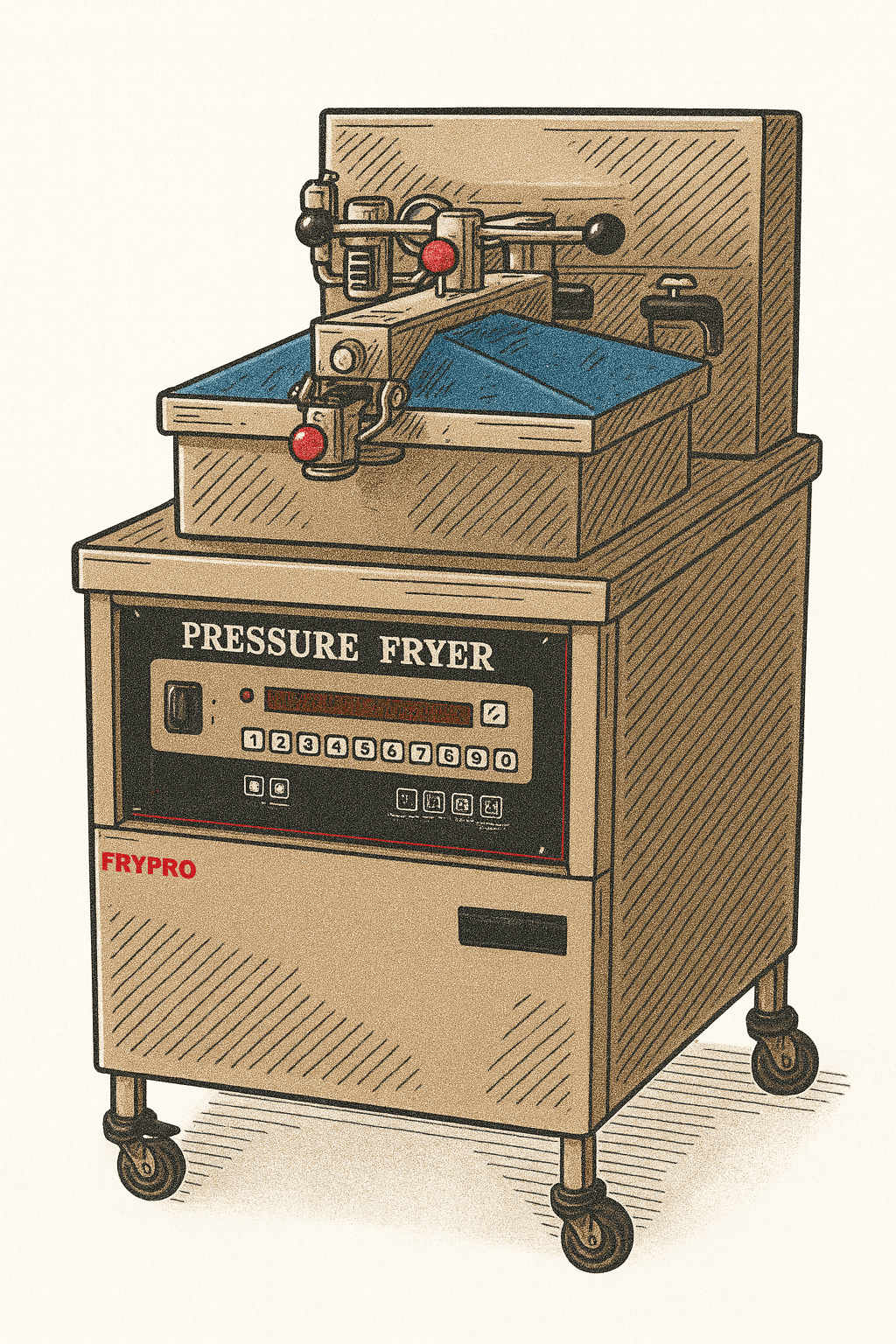
How does a pressure fryer work?
A commercial pressure fryer cooks food in an oil bath under a locked lid. Steam from the water contained in the food helps increase pressure inside the pot. A regulating system and machine safety features manage this pressure.
Pressure increases the boiling point of water, not that of oil. It can limit food moisture loss and promote tender meat. Results and cooking times depend on the recipe, piece sizes, batch load, and settings: they must be verified in accordance with the manual and your food safety management plan.
Discover specifications and pricing for the EXTRA-25 and PRO-25
Comparing with another brand? Read our analysis: alternatives to Henny Penny.
To view the entire range and cookline, see our pressure fryer for fried chicken.
Why Choose a Pressure Fryer?
Cycles tailored to production
Pressure frying can reduce cooking times for certain preparations. Measure actual throughput with your recipes, without inferring output from tank capacity alone.
Preserved Juiciness
Cooking conditions can limit moisture loss. Tenderness also depends on raw ingredients, recipe, and cycle control.
Consumption to evaluate
Compare power rating, temperature recovery, preheating, and idle periods. Quantifying savings requires measurements under identical conditions.
Safety and training
Hot oil and pressure remain hazardous. Never open before complete depressurisation; train operators and follow the inspection checks specified by the manufacturer.
Automatic vs Manual Filtration
The filtration system manages oil maintenance, not the pressure frying principle itself. Choose between a built-in pump and manual filtration based on your workflow and the procedure set out in the manual. For commercial specifications, compare the FRYPRO EXTRA-25 and PRO-25 models.
For frying oil filtration outside the unit, FRYPRO offers a mobile filter; and if your kitchen already uses a Henny Penny fryer, a stainless steel basket compatible with Henny Penny is available. Check compatibility on each product sheet.
Filtration Automatique
WITH BUILT-IN PUMP
Filtration pump built-in: the cycle is carried out according to the procedure and frequency recommended by the manufacturer
Do not confuse a built-in pump with continuous filtration : the cycle may require pausing cooking and manual handling
Maintenance workflow : the pump helps circulate the oil through the filtration system
Particle removal : also monitor oil quality and breakdown
Filtration and replacement : filtering does not replace regular checks or discarding degraded oil
👍 Ideal for:
- • High-volume restaurants
- • All-day continuous service
- • Operators seeking maximum efficiency
- • Reducing staff workload
Manual Filtration
WITHOUT BUILT-IN PUMP
Same pressure cooking principle ; filtration is about oil maintenance
Oil filtration carried out manually, following the frequency and safety precautions specified by the manufacturer
More affordable price for tighter budgets
Straightforward maintenance with manual oil filter (included)
Regular maintenance : allow time for filtering, cleaning, and safety system checks
👍 Ideal for:
- • Establishments with a suitable electrical installation
- • Volume aligned with planned cycles
- • Limited initial budget
- • End-of-service filtration is acceptable
Quick Comparison Table
| Specification | Filtration Automatique | Manual Filtration |
|---|---|---|
| Filtration pump | ✅ Built-in | ❌ No |
| Automatic filtration | ✅ Yes | ❌ Manual |
| Cooking quality | Depends on recipe and settings | Depends on recipe and settings |
| Cooking time | Depends on recipe and batch size | Depends on recipe and batch size |
| Daily maintenance | Refer to user manual | Manual filtration |
| Recommended volume | To be verified in real operating conditions | To be verified in real operating conditions |
| Price |
Which criteria should you check before choosing?
- Capacity and batch size: tank volume does not directly equate to chicken weight per cycle. Check the recommended batch limits and the required oil level.
- Installation: confirm voltage, available power, connections, ventilation, clearances, and equipment weight with a qualified professional.
- Workflow and operations: factor in the full cycle time: loading, cooking, depressurisation, unloading, temperature recovery, and maintenance.
- Safety: ensure staff training, regularly inspect gaskets and valves, and follow the manual for every operation.
- Maintenance and after-sales service: compare filter accessibility, consumables, spare parts availability, and technical support.
Guides & Advice
Need Help Choosing?
Our team of experts is on hand to advise you on the model best suited to your needs